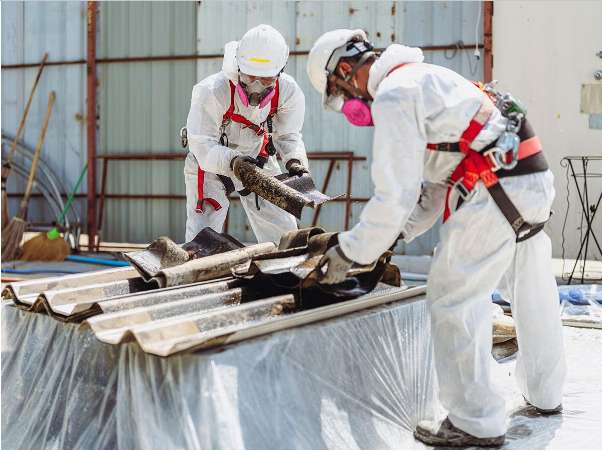
Asbestos can be buried in older commercial buildings, industrial facilities, warehouses, schools, and other locations for decades. It may be found in cement sheeting, insulation, flooring, roofing products, pipe lagging, and other construction materials. The problem arises when restoration, maintenance, or demolition activity disturbs certain materials.
Commercial asbestos abatement is more than just getting dangerous material out of a structure. It includes identification, planning, controlled removal, decontamination, waste management, and, if necessary, independent clearance. The specific regulations vary by Australian state and territory, but the basic premise remains consistent: asbestos must be managed in a way that prevents exposure to airborne fibres.
1. Identifying asbestos before work begins
The first step is to determine whether asbestos-containing material (ACM) is present and where it is located.
A commercial facility may already have an asbestos register and management plan, especially if workplace asbestos management requirements apply. If asbestos is suspected but its existence or condition is unknown, a qualified individual should inspect the material. Where asbestos is suspected, Safe Work Australia recommends scheduling an examination and hiring a licensed asbestos removalist.
2. Sampling and assessment
Identification should take place before any intrusive work begins. Simply judging a material’s appearance is not a good technique to determine whether it contains asbestos.
The assessment should take into account the material’s location, condition, and kind, as well as any scheduled construction or maintenance operations that may disrupt it. This information is used to assess the proper controls and, when relevant, the type of licensed removal activity required.
3. Planning the removal work
After asbestos has been detected, the next stage is to establish a safe and controlled approach to the task.
For larger commercial projects, preparation may include an asbestos management strategy, risk controls, site access limitations, personal protective equipment, decontamination arrangements, and procedures for managing and disposing of asbestos material. Safe Work Australia’s model code also distinguishes between Class A and Class B permitted removal work, with licensing requirements varying based on whether the material is friable or non-friable.
The work must also account for those who are not directly involved in the removal. Employees, contractors, tourists, neighbouring businesses, and members of the public may all be present in an active workplace.
4. Setting up a controlled work area
Before physical removal begins, the work area must be regulated to prevent illegal access and limit the spread of asbestos fibres.
Depending on the project, controls may include barriers, warning signs, restricted access, work area separation, and specific containment measures. Additional precautions, such as negative-pressure enclosures and air monitoring, may be required for higher-risk jobs.
The goal is not merely to protect the workers doing the removal. Effective containment also decreases the risk of asbestos contamination spreading into occupied or adjacent areas of a property.
5. Carrying out commercial asbestos abatement
The removal process must be carried out using work procedures appropriate to the material and its state. Friable asbestos, for example, has different control requirements than intact non-friable ACM since it can easily release airborne fibres.
Licensed asbestos removalists utilise recognised control procedures to reduce fibre release, as well as suitable respiratory and other personal protective equipment. Depending on the circumstances, workers, equipment, and protective clothing may need to be decontaminated.
The work shall not exceed the scope of the agreed-upon control measures. If asbestos-containing material is discovered during a renovation or demolition project, work may have to be halted while the material is examined, and the removal strategy is discussed.
6. Cleaning and decontamination after removal
Removing visible asbestos is simply one aspect of the procedure. The work area must also be thoroughly cleaned to ensure that no asbestos residue remains.
An asbestos control plan may include cleaning methods, decontamination procedures, and provisions for equipment and PPE.
This stage is especially essential for commercial properties because the area may potentially be repurposed for office use. Rushing from physical removal to reconstruction or occupation can provide unnecessary dangers if residue or contamination are not appropriately treated.
7. Inspection and clearance
Depending on the nature and scope of the work, an independent inspection and clearance procedure may be required before the space may be reoccupied.
For example, Victorian employment guidelines require an independent person to undertake a visual examination and, if required, a clearance certificate before reoccupying specific places. Certain friable asbestos cleanup projects may require additional air monitoring.
Standards vary across Australia, thus property owners and project managers should check the rules in their state or territory rather than assuming that one jurisdiction’s standards apply nationally.
8. Transporting and disposing of asbestos waste
The final stage involves the controlled disposal of asbestos waste. Removed ACM, contaminated disposable PPE, and other asbestos-related waste must be stored and transported in compliance with applicable regulations.
Disposal cannot easily be done with typical building waste. For example, the NSW Environment Protection Authority specifies that asbestos trash can only be disposed of at a licensed landfill, and it is recommended that you call the facility ahead of time to confirm their requirements.
Commercial projects should consequently explore disposal plans before beginning the removal process. Knowing where the waste will go helps to avoid delays and lowers the likelihood of incorrectly treated asbestos entering the general waste stream.
9. Why the process matters
Commercial asbestos removal is a coordinated process rather than a single activity. Identification identifies what is there, planning creates suitable controls, removal removes the hazardous material, cleaning lowers residual contamination, clearing confirms that the area can be safely returned to use, and compliant disposal completes the process.
Understanding these steps can help property owners, facility managers, and contractors plan and manage asbestos projects more effectively. More importantly, it demonstrates why suspected asbestos should not be disturbed casually. When professional analysis, removal, or disposal is required, the safest approach is to hire adequately qualified and licensed personnel and check the rules in the relevant Australian jurisdiction.