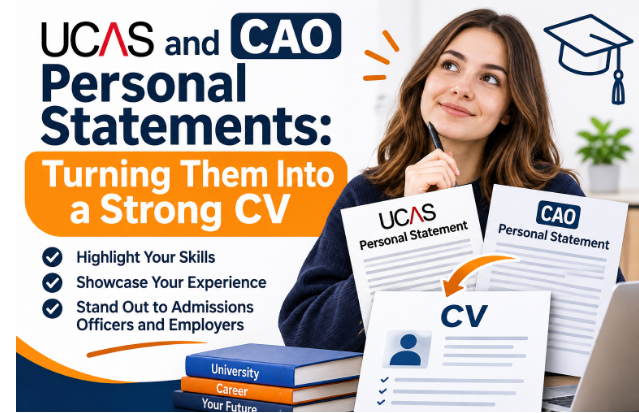
If you’ve applied through UCAS in the UK or the CAO in Ireland, you’ve already done something many job applicants struggle with: you’ve written about yourself, your strengths, and your goals. The challenge now is to turn that material into a CV that suits employers rather than admissions tutors. With the right approach, your old personal statement can become a valuable starting point.
This guide shows how to adapt it, what to keep, what to replace, and how to build a CV that works for placements, part-time jobs, and graduate roles.
Understand the Difference in Purpose
A personal statement is aimed at admissions tutors. It explains why you want to study a subject, shows your enthusiasm, and gives examples of related reading, activities, and skills. A CV is aimed at employers. It’s shorter, more structured, and focused on what you can do for the organisation.
Ireland has no UCAS-style personal statement for most CAO applications, which rely on exam results, but many applicants, especially for postgraduate, mature, or UK routes, still write one. If you have one, use it as a source of raw material. If you don’t, the same exercise works with a short reflection on your strengths and interests.
What to Keep From Your Statement
Look back through your statement and pull out:
- Specific examples of skills, such as teamwork, leadership, research, or problem-solving
- Relevant activities, including clubs, volunteering, sport, and creative projects
- Achievements, such as awards, competitions, and responsibilities
- Your motivation, which can be turned into a short profile
- Subject knowledge, where it supports the type of job you want
What to Leave Behind
Admissions writing often contains elements that don’t belong on a CV:
- Long reflections on why you love a subject
- References to books, lectures, or theories without a practical outcome
- Descriptive language about your passion or dream
- Generic claims about being hardworking or enthusiastic
- Detail about courses you haven’t started or decided on
Replace these with concise statements and evidence. Employers want to see actions and results, not reflections.
Step-by-Step: Converting Your Statement
Step 1: Highlight achievements and skills. Mark every example where you did something, led something, or improved something.
Step 2: Turn each example into a bullet point. Start with an action verb, describe the task, and add the result. For example, “Organised a fundraising event for 120 attendees that raised €1,800 for a local charity.”
Step 3: Write a short profile. Condense your motivation into three or four lines that state who you are, what you study or have studied, and what you’re seeking.
Step 4: Add education details. Include your school or university, subjects, and grades, plus relevant modules or projects.
Step 5: Include experience. Part-time jobs, volunteering, work placements, and responsibilities all count, so treat them seriously.
Step 6: Add skills and extras. Languages, software, driving licence, certifications, and relevant interests.
Step 7: Tailor and proofread. Match the language to the job advert, then check spelling, dates, and layout.
Example: Before and After
From a personal statement:
“I’ve always been passionate about business, and my role as captain of the school enterprise team showed me the importance of communication.”
On a CV:
“Captain, school enterprise team: led six students to develop and pitch a product at a regional competition, finishing in the top three.”
The CV version is shorter, more specific, and gives the reader something to verify.
Choosing the Right Format
For students and early-career applicants, a one-page CV is usually ideal, with two pages acceptable when you have substantial experience. Use a clean, single-column layout with standard headings: Profile, Education, Experience, Skills, and Interests. Many employers use applicant tracking software, so avoid text boxes, tables, and graphics. Save the file as a PDF unless told otherwise.
Getting Support With the Process
If you aren’t sure where to begin, a reliable CV Ireland provider can guide you through the structure and wording, particularly for first-time applicants who’ve never written one. For those who prefer to start with a professionally designed layout that parses cleanly, a CV making service can supply a clean template and help you fill it with your own achievements.
It can also be useful to work with an Irish CV Writing Service that understands local employers, from graduate programmes in Dublin and Cork to part-time roles and placements across the country. That local insight helps with details such as length, content, and what recruiters expect to see.
Don’t Forget Your Online Profile
Employers often look you up before inviting you to interview. Create a professional profile with a clear photo, a headline that states your course and goals, and a short summary drawn from your personal statement. Add projects, volunteering, and skills. If you’re unsure how to word it, a linkedin profile specialist can help you build something that matches your CV and works in recruiter searches.
If you’d rather get hands-on guidance, look for help writing linkedin profile content that focuses on your achievements instead of generic phrases, so your profile and CV tell the same story.
Common Mistakes to Avoid
- Copying the personal statement directly into the CV
- Using the same document for every application
- Focusing on passion instead of results
- Leaving out part-time jobs and volunteering because they seem unimportant
- Including too many hobbies or irrelevant detail
- Forgetting to update the CV after each new achievement
Making the Most of Your Experience
Students often underestimate their experience. A café job shows reliability and customer service. A sports team shows teamwork and discipline. A volunteering role shows initiative. Describe each in terms of skills and outcomes, and the CV becomes far stronger than the original statement alone.
A Quick Checklist
- Does the CV fit on one or two pages?
- Does each bullet start with an action verb?
- Have I included numbers wherever possible?
- Is the profile specific to the job I’m applying for?
- Are dates, names, and spelling accurate?
- Does my online profile match?
Final Thoughts
Your UCAS or CAO personal statement shows that you can reflect on your goals and communicate them. Turning it into a CV means condensing, focusing on evidence, and tailoring for each role. Use the statement as raw material, add what you’ve achieved since, and you’ll have a document that moves you from applicant to candidate. Revisit it every term, and keep it ready for the next opportunity.